Every carpenter knows that quality work requires not only skilled hands and good machinery, but also a space where one can work comfortably. However, as production grows, a workshop can gradually become filled—not just with new orders, but also with equipment, dust, and waste that need to be cleared away regularly.
This is precisely the challenge Mr. Lubomír Srnský faced at his custom woodworking shop in Prosečné, Czech Republic. His original ADAMIK FT 504 dust extraction unit had served him well for a long time, but as production demands grew, it was no longer sufficient.
It was necessary to find a solution capable of doing more than just extracting sawdust. One that would free up space in the workshop, improve the working environment, and simultaneously simplify waste management.
When simply swapping one machine for another isn’t enough
When designing the new solution, we therefore did not look solely at extraction performance. Together, we sought a way to better organize the entire operation and integrate the individual technologies so that they would support one another.
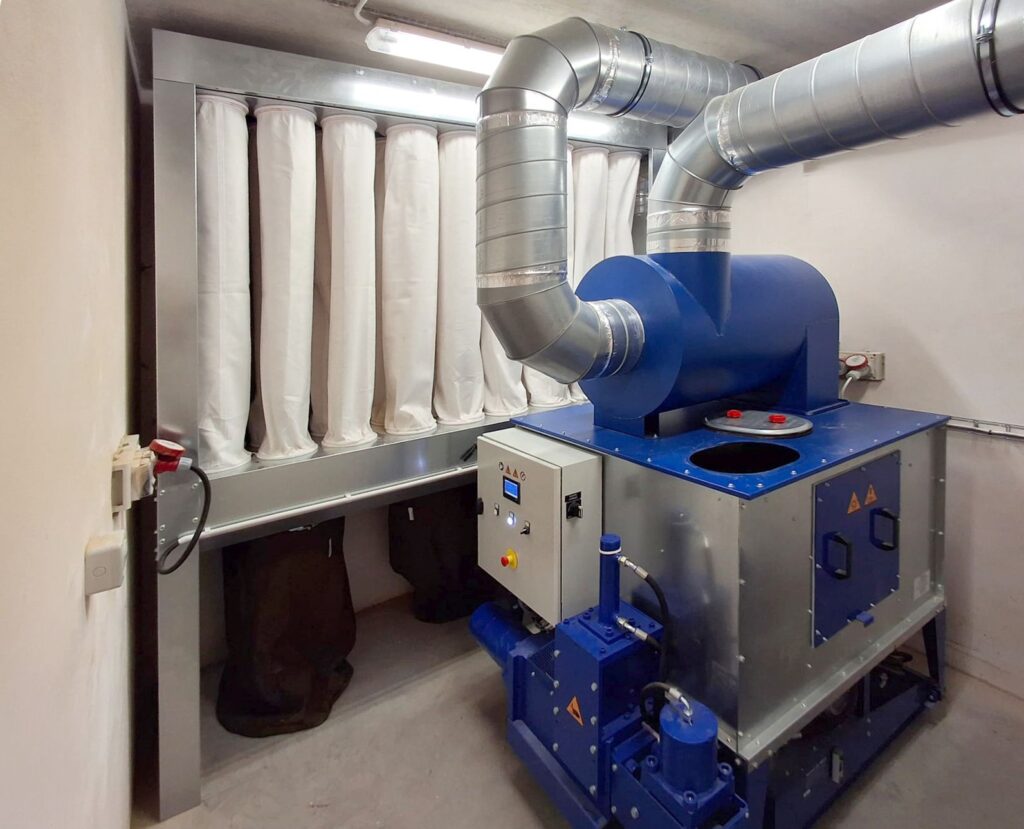
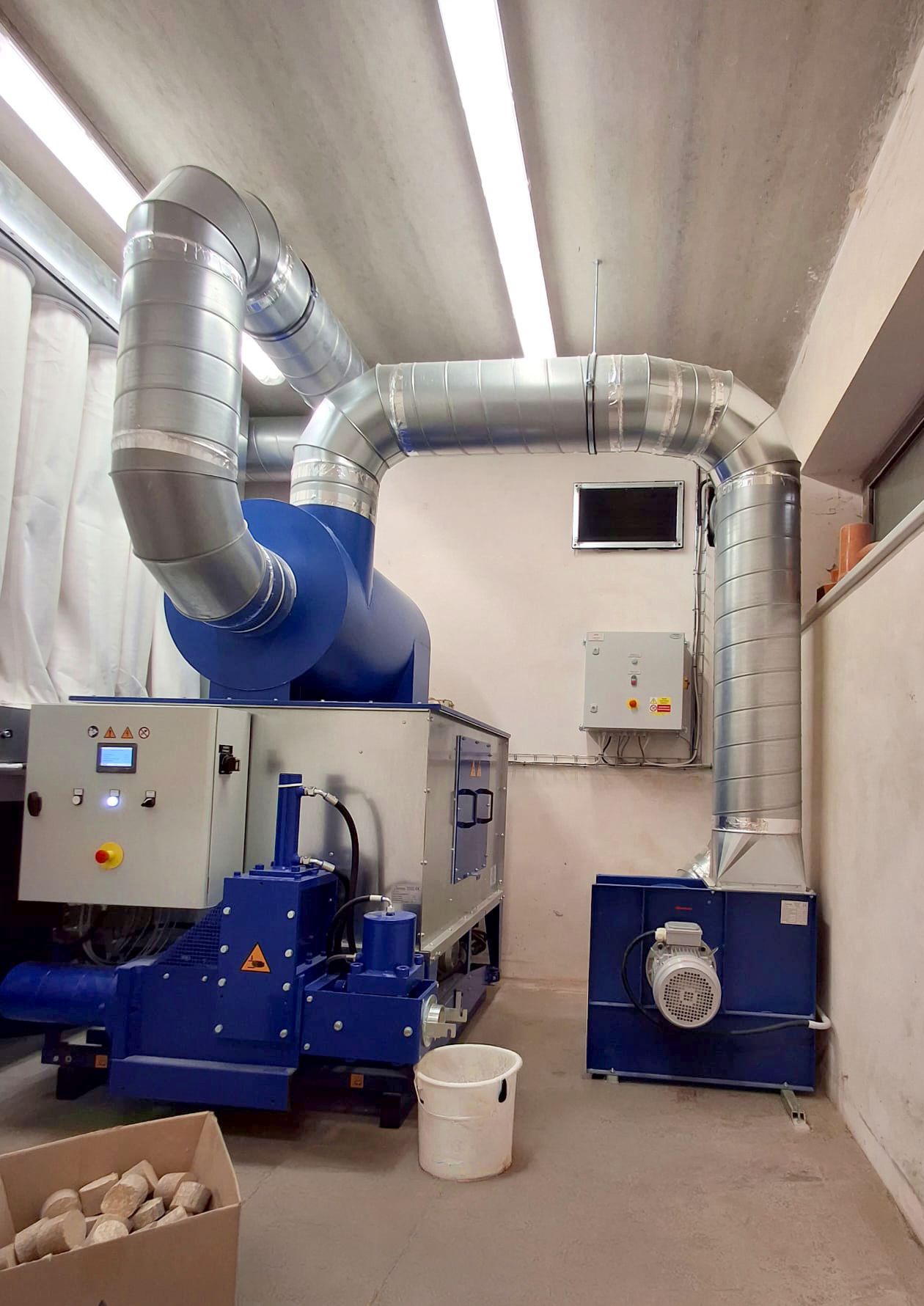
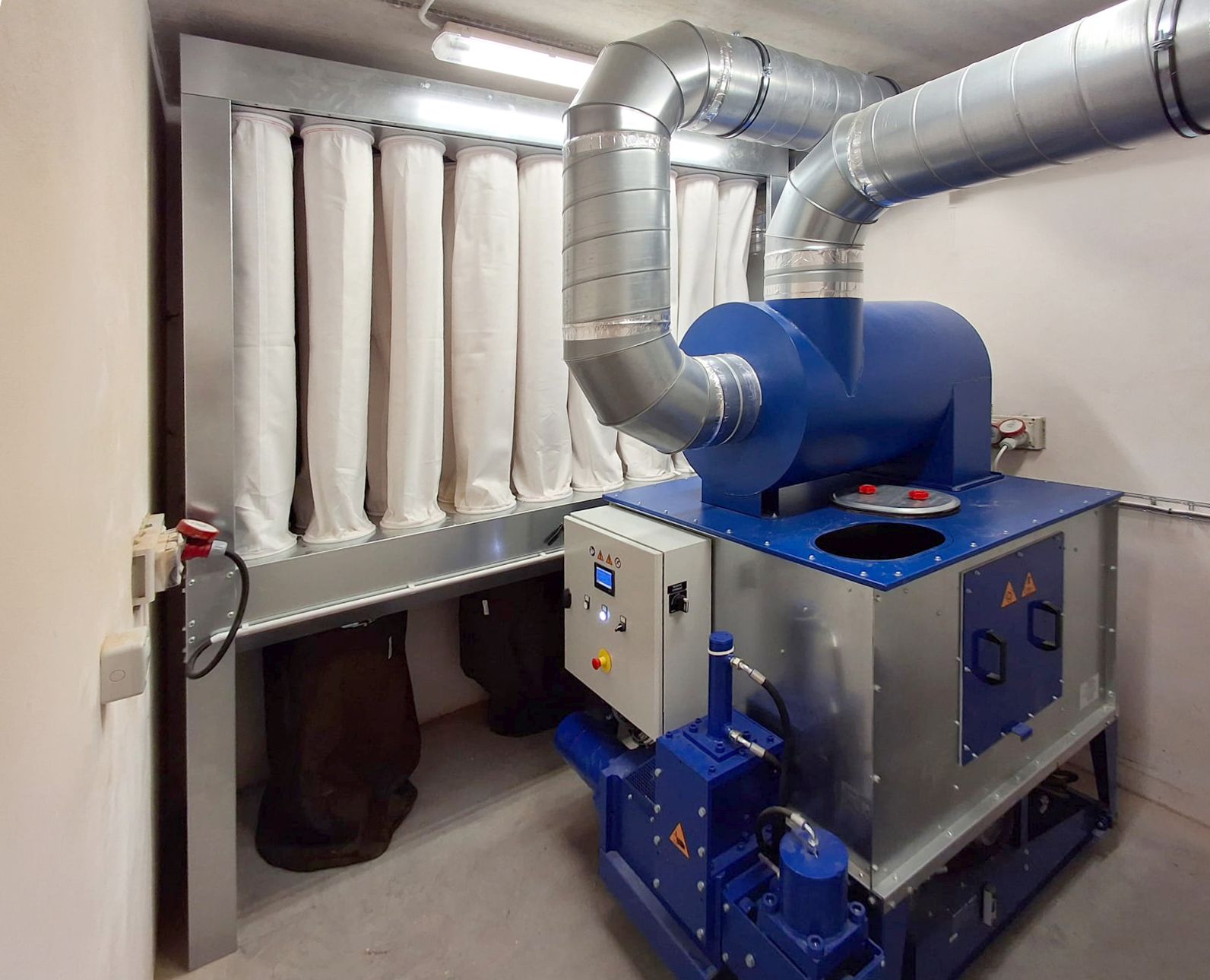
The result was the placement of both the extraction system and the briquetting press in a separate utility room. This kept the machines out of the main workspace, freeing up more room in the workshop for what matters most: the production process itself.
The solution includes an EBS assembly, consisting of:
- filtration unit FT 627N with a 4 kW ventilator,
- briquetting press BRK 30-12,
- horizontal cyclone ACL 700,
- connecting piping with a clean-air return system.
It is not just a matter of a few machines placed side by side. The entire setup functions as an interconnected system, in which each part has its own role.
Briquettes straight from sawdust. Without any unnecessary extra work.
One of the greatest advantages of the new solution is the way it handles waste generated during production.
The extraction system collects sawdust and transports it via piping system —featuring an integrated horizontal cyclone—to a briquetting press. The briquetting press converts the wood waste into heating briquettes, which can subsequently be used as solid fuel.
Consequently, waste does not need to remain in bags that would otherwise require manual removal and further handling. Thanks to the integration of the various technologies, processing takes place automatically, with no additional manual labor required during the system’s standard operation.
That is precisely where the true value of the entire solution lies. It is not just about more powerful extraction, but about a simpler and smoother workshop operation.
What has changed in daily operations?
The new arrangement brought several practical advantages:
More space for production. Neither the extraction unit nor the briquetting press takes up space directly in the workshop anymore. The freed-up space can be used for work, material handling, and further production development.
A more pleasant work environment. Moving the technology outside the workshop reduced noise and dust in the workspace.
Less manual handling of waste. Sawdust is automatically conveyed to the briquetting press, eliminating the need for manual removal and transport.
Better utilization of generated waste. Material that would otherwise have to be removed is converted into briquettes that can be used as solid fuel.
Each of these changes has its own significance. Taken together, however, they bring something even more important: fewer unnecessary tasks throughout the day and more room to focus on one’s own craft.
Technology should serve people, not create extra work.
When modernizing production, a simple solution sometimes presents itself: replacing existing equipment with more powerful units. However, this is not always the best approach.
The experience of Mr. Srnský’s carpentry workshop demonstrates that a significant difference can only be achieved by changing the entire concept. When technologies are correctly integrated and tailored to a specific operation, they can collectively solve several problems at once.
At ADAMIK Company, therefore, we don’t just look for the answer to what kind of machine a customer needs. We are also interested in how they work, what slows them down during operations, and what could genuinely make their daily work easier.
Because a good technical solution isn’t defined solely by its specifications. It is defined, above all, by how well it serves the people who work with it every day.